Hospitality operators have a growing technology agenda. Demand is becoming harder to predict, labour and energy costs remain under pressure and guest expectations continue to rise. Technology can change those economics through better revenue decisions, more targeted personalisation, smarter workforce planning, automation and more predictive property operations.
But for many mid-market hospitality businesses, there is a missing layer between executive intent and technical delivery.
The business owns the outcomes and understands how hotels actually operate. IT owns the technology estate, architecture, data and controls. Software vendors and system integrators know their products. Someone still needs to orchestrate the programme across all three.
Without that transformation layer, important decisions fall between organisational boundaries or escalate unnecessarily to senior executives.
Lean technology teams need flexible transformation capacity
Many hospitality businesses have deliberately lean central functions. Their IT teams are designed to run and support the technology estate, manage suppliers and maintain core services. They do not have a permanent bench of programme managers, business analysts, architects and transformation specialists waiting for the next major implementation.
Nor would maintaining that capacity permanently make economic sense.
Transformation creates a temporary need for additional capability: shaping requirements, coordinating vendors, managing dependencies, challenging design decisions, preparing the business for change and maintaining control over scope, risk and benefits. A transformation partner provides that capacity when it is needed without requiring the operator to build a larger permanent function.
Executive sponsorship cannot become executive project management
Technology transformation needs strong business ownership. It also needs to protect scarce operational and executive bandwidth.
Without an effective programme layer, relatively detailed questions quickly travel upwards. Which process takes precedence? Is a vendor change within scope? Who owns an integration issue? Can a design decision be deferred? Does a proposed customisation genuinely support a business requirement?
Executive sponsors should set direction, make the material trade-offs and hold the programme to account. They should not become the mechanism through which everyday delivery decisions are resolved.
A strong transformation layer creates decision discipline. It makes sure the right issues reach executives, with the implications understood, while routine delivery decisions are resolved by the people equipped to make them.
Technology transformation is a capability in its own right
Hospitality teams bring the operational knowledge that a transformation needs. They know the guest journey, property constraints, commercial priorities and practical realities of running hotels.
Successful delivery also requires experience of how technology programmes fail, how systems interact and what good implementation looks like.
Klarus’s recent independent research of 500 mid-market organisations in the UK and Ireland found that 48% of respondents who had explored AI cited a lack of AI expertise as a joint top reason for projects failing to move beyond pilot. The same principle applies more broadly to technology transformation: ambition and business knowledge do not automatically provide the specialist delivery capability required to execute well.
Seemingly small implementation decisions can create disproportionate operational consequences. We have seen this in practice:
- a housekeeping system configured to the wrong time zone, preventing accurate time tracking and creating manual work to calculate payments to outsourced housekeepers
- a procurement system implementation that still required key invoice fields to be manually rekeyed from PDFs
- a finance system that launched with dozens of users holding system administrator permissions, creating unnecessary risk to critical configuration and data
- a CRM programme intended to use an off-the-shelf product that gradually became a heavily customised solution without the executive sponsors understanding how far the design had moved from the original intent
“These examples show how the value of an otherwise sound technology investment can be eroded.”
Protecting that value requires experienced people close enough to the detail to identify poor decisions early, challenge them and keep delivery aligned to the intended outcome.
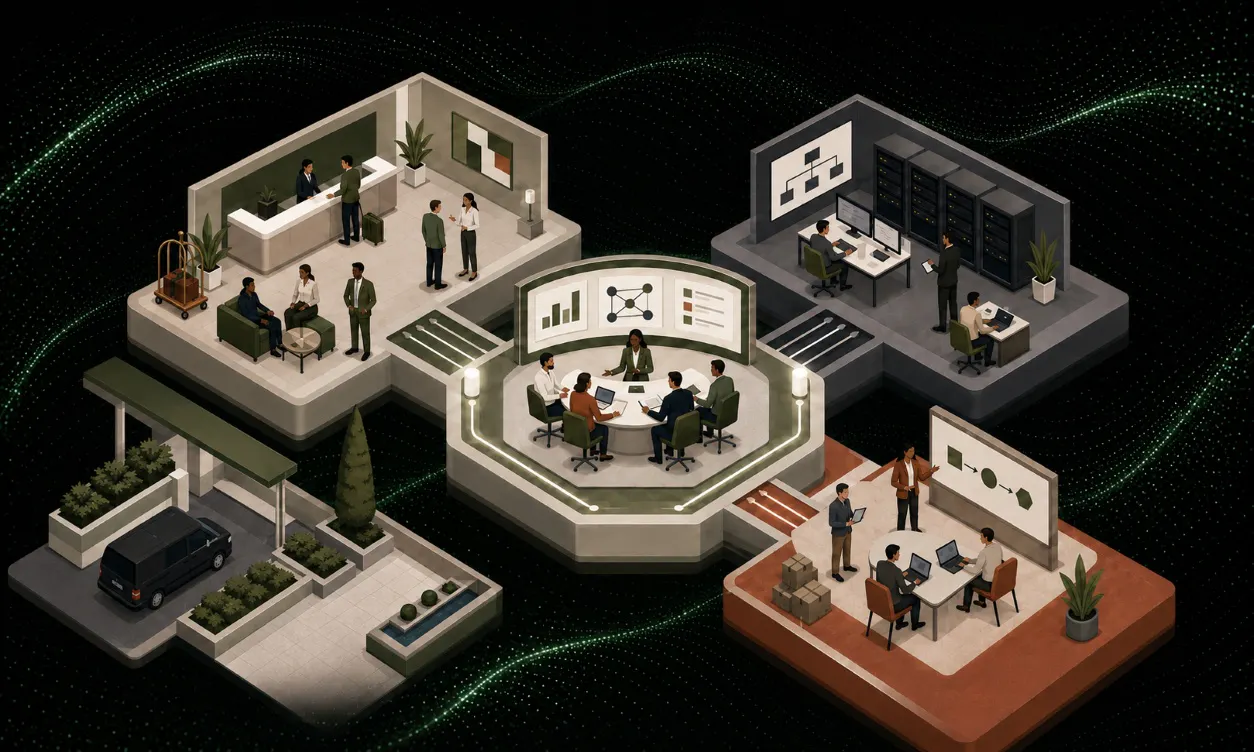
This is the role of the transformation partner: connect the business, IT and delivery ecosystem, maintain control of the programme and bring specialist experience where it is needed.
Klarus provides that transformation layer for hotel owners and operators, connecting business leadership, IT teams and delivery partners while bringing in specialist expertise where it is needed.
We are vendor-agnostic and sell no software, so we start with the business outcome and remain accountable for helping the organisation translate it into delivery. From investment cases and programme design through to implementation leadership, our role is to make technology change manageable for the organisation and measurable for the business.